Last updated November 17, 2026
ADU Emergency Preparedness Guide for Las Vegas Homes
In 2023, the National Weather Service recorded 19 days above 110°F in Las Vegas. At that temperature, an ADU without a working HVAC unit can become uninhabitable in under four hours. That fact reframes everything you thought “emergency preparedness” meant for a backyard home. Las Vegas doesn’t have an earthquake problem or a hurricane season. It has a heat problem, a monsoon drainage problem, and a power-grid problem, and all three are statistically likely to hit your ADU within its first decade. This guide covers the specific protocols, shutoffs, load calculations, and insurance records that keep a Las Vegas ADU safe when the grid, the HVAC, or the sky fails.
Quick Answer
Emergency preparedness for a Las Vegas ADU means planning for three specific scenarios: extreme heat with HVAC failure, flash flooding from monsoon storms, and extended power outages during peak cooling demand. Every Las Vegas ADU owner should know the location of the ADU’s separate electrical shutoff and water shutoff, keep a documented pre-loss photo and record file for insurance claims, and have a written heat-emergency protocol for anyone living in the unit. Each of these takes under an hour to set up and prevents the majority of ADU emergency losses we see.
Table of Contents
- Heat Emergency Protocol: When the HVAC Fails
- Portable Cooling Thresholds for Safe Habitation
- Utility Priority Restoration and NV Energy Contacts
- Flash Flood Preparedness and Monsoon Drainage Inspection
- Caliche Layer Drainage Failure Signs
- Power Outage Planning and Generator Load Calculations
- ADU Utility Shutoff Locations and Tenant Documentation
- Insurance Documentation to Protect Your ADU Claim
Heat Emergency Protocol: When the HVAC Fails
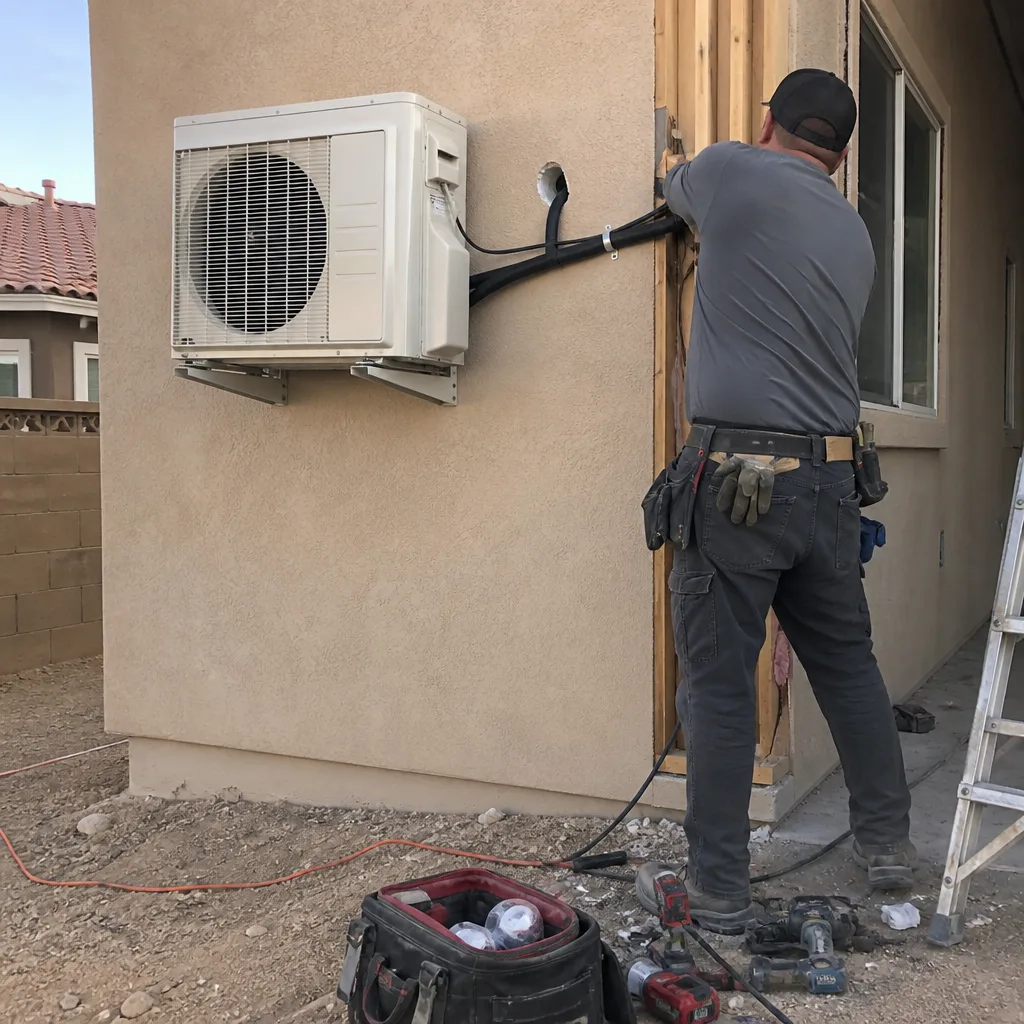
An HVAC failure in a Las Vegas ADU is a life-safety event, not a comfort problem. Interior temperatures in a poorly insulated ADU can climb faster than outdoor ambient during peak sun because the thermal mass of the structure holds and radiates heat. The protocol matters more than the repair.
- Verify the failure. Check the thermostat setpoint, the breaker at the ADU subpanel, and the filter. A tripped 240V breaker at the subpanel is the single most common false alarm.
- Move occupants out within the first hour. If outdoor temperature is above 105°F and indoor temperature is climbing past 90°F, occupants should relocate to the main house, a cooling center, or a family member’s home. Do not wait for a repair technician.
- Shade and seal. Close all window coverings on south- and west-facing windows. Open windows only if outdoor temperature is lower than indoor, which in Las Vegas summer is rare after 9 a.m.
- Set up portable cooling. A single 5,000 BTU window or portable unit will not cool an entire ADU. Use it to hold one small room below 85°F as a refuge.
- Log the call. Record the time you called for service, the technician’s name and license, and the arrival time. If the unit is under warranty or a service contract, this record matters.
We’ve seen ADUs in the older neighborhoods near Sunrise Manor where a 10-year-old packaged HVAC unit is the only cooling source. There is no second system, no evaporative cooler backup, and no window unit in storage. That is a single-point-of-failure design, and it is the most common heat-emergency cause we encounter in Las Vegas.
Portable Cooling Thresholds for Safe Habitation
Safe habitation is not a comfort benchmark. It’s a threshold below which a healthy adult can sleep and work without heat stress. In Las Vegas, the practical thresholds for an ADU are specific.
- 84°F: Upper limit for young children, elderly occupants, and anyone with cardiovascular or respiratory conditions.
- 88°F: Practical upper limit for a healthy adult to sleep.
- 95°F: The point at which indoor temperatures begin to cause heat-exhaustion symptoms in healthy adults.
- 100°F+: Uninhabitable. Occupants must evacuate regardless of repair schedule.
A 5,000 BTU portable unit cannot cool a 500-square-foot ADU below these thresholds on a 112°F day. It can hold a 120-square-foot bedroom. Plan accordingly. The threshold that matters is the room you will shelter in, not the whole unit. Window units in a converted garage ADU need the same commitment: one dedicated refuge room with its own cooling. If your ADU was permitted through our Garage Conversion ADU in Las Vegas process, the permit set will show you the rated cooling load and the intended cooling equipment, which is where this calculation starts.
Utility Priority Restoration and NV Energy Contacts
NV Energy maintains priority restoration lists for customers with medical needs and critical care requirements. If an ADU occupant depends on powered medical equipment, the enrollment happens at the account level, not the address level, and it must be renewed periodically. If an occupant has a documented heat-related medical vulnerability, that is the pathway that puts the ADU higher on the restoration sequence during a summer outage.
For outages that are not medical-priority, restoration follows circuit and load priority. A single ADU on a residential circuit in the neighborhood around Green Valley restores with the main property. There is no separate ADU restoration queue. Do not wait on the ADU’s circuit alone. Verify your account number, meter number, and outage status for the whole parcel.
Keep on the ADU’s written emergency card:
- The NV Energy outage line and account number.
- The medical-priority enrollment confirmation, if applicable.
- The ADU permit number and the property address, for any utility representative who needs to locate the meter.
Note that the ADU may not have its own NV Energy account. In most Las Vegas parcels, the ADU is sub-metered or shared-metered with the main house. In a shared-meter configuration, the ADU has no separate outage status.
Flash Flood Preparedness and Monsoon Drainage Inspection
Las Vegas monsoon season runs roughly July through September, and the flash floods that hit the valley are not the slow-rising kind. Storm water on the west side collects against the Spring Mountains, runs into the wash systems, and arrives at low-lying parcels in minutes. An ADU’s drainage failure mode is not the roof leak; it is water pooling against the slab and against the base of the exterior walls.
Inspect the following before every monsoon season. This is an annual, 30-minute routine:
- Grading. Confirm the ground slopes away from the ADU on all sides at a minimum of six inches of fall across the first ten feet. Look for settlement that has re-created a low spot against the wall.
- Roof drainage. Clear gutters, scuppers, and downspouts. Verify that downspouts discharge at least four feet from the foundation.
- Site drains. Clear area drains, channel drains, and any French drain outlets on the parcel. A clogged drain is invisible until it fails.
- Slab and stem wall. Check for water staining, efflorescence (the white mineral powder), and cracks that have opened since the last wet season.
- Yard flow paths. Confirm that runoff from the main house, driveway, and neighboring parcels does not route through or against the ADU footprint.
Flash flood risk on a given parcel is a matter of record. Look up the ADU parcel on the FEMA Flood Map Service Center before you plan anything else. If the parcel sits in a Special Flood Hazard Area, flood insurance for the ADU becomes a separate decision that most homeowners in Las Vegas are surprised to discover applies to them.
Caliche Layer Drainage Failure Signs
Caliche is the cemented calcium-carbonate layer that underlies much of the Las Vegas valley. It is why local excavation is a specialty trade and why drainage behaves differently here than in other markets. Caliche is naturally impermeable. Water does not soak through it. It runs along the top of the layer until it finds an edge, a crack, or a low point.
Signs that caliche is interfering with your ADU’s drainage:
- Standing water persists in the yard for more than a few hours after a monsoon storm.
- Water emerges at the base of a slope or at a wall footing rather than soaking in at the surface.
- A newly planted area near the ADU stays waterlogged while the rest of the yard dries at a normal rate.
- Efflorescence appears on the interior side of the ADU’s stem wall or along the base of drywall.
If you see these signs, the fix is not more soil. It is a designed drainage pathway and, in some cases, a perforated drain line routed to a discharge point that the parcel is permitted to use. This scope crosses into site work, and it is why our Ellery ADU Studio Las Vegas home page describes the site prep and utilities scope as part of the same contract as everything else. Drainage failure is a design problem, not a repair problem.
Power Outage Planning and Generator Load Calculations
The question is not whether you can run the whole ADU on a portable generator. The question is what wattage maintains a minimum safe cooling load. In a Las Vegas ADU, the minimum is not the HVAC compressor. A whole-home portable generator large enough to start a residential AC compressor is an uncommon installation that most homeowners will not pursue. A more practical plan runs room cooling, lighting, refrigeration, and communications.
Typical portable generator loads for an ADU:
- Room AC (portable or window unit): 900 to 1,400 running watts, 2,500+ starting watts.
- Refrigerator: 150 to 400 running watts, 1,200 starting watts.
- LED lighting: 50 to 150 watts.
- Phone and device charging: under 100 watts.
- Well pump, if applicable: 750 to 1,500 watts.
A 3,000 to 5,000 running-watt generator covers a small ADU cooling refuge plus the essentials. Verify your actual equipment nameplate before sizing.
Connection method matters under NEC. A portable generator must not be back-fed into the ADU’s wiring by plugging it into any outlet. That is a code violation and it can back-feed onto the utility line. The compliant path is a listed transfer switch or an inlet box installed by a licensed electrician, and the standby or inlet circuit must be sized to the generator. The transfer switch belongs on the ADU’s subpanel, not on the main house panel, if you intend to power the ADU only. If your ADU was permitted through our ADU Design & Permitting in Las Vegas process, the panel and circuit documentation from the permit set shows the subpanel capacity and the available breaker space for a transfer switch.
ADU Utility Shutoff Locations and Tenant Documentation
The single most common emergency-response failure in a Las Vegas ADU is not knowing where the shutoffs are. The owner knows the main house shutoffs. The ADU shutoffs may or may not be the same ones.
- Electrical. A detached or converted ADU has its own subpanel. The ADU subpanel often has a main breaker that shuts everything in the ADU without affecting the main house. Confirm this during a routine inspection, not during an emergency.
- Water. The ADU typically has either a dedicated shutoff valve on the branch line from the main property or shares the main property shutoff. A dedicated valve, when present, is a real time-saver in a leak.
- Gas. If the ADU is served by gas (range, water heater, furnace), there is either a dedicated valve on the branch or a shared main property valve. Never shut gas off as a routine step. If you smell gas, leave the unit and call the gas utility.
- HVAC. The disconnect at the condenser, not the thermostat, kills power to the outdoor unit. Confirm its location and label it.
Provide the ADU occupant with a one-page emergency card: shutoff locations, the phone number to call you, the NV Energy outage line, and the address of the nearest cooling center. Photograph each shutoff and label it in the card. That photograph is also part of your insurance record, covered below.
Insurance Documentation to Protect Your ADU Claim
The largest single reason ADU emergency claims get disputed is a lack of pre-loss documentation. The insurer’s question in a claim is not “was the ADU damaged?” It is “what was the condition of the ADU before the loss?” If the answer is a photo from three years ago, the dispute begins.
Maintain the following file, updated annually:
- Exterior and interior photo set. Wide shots, then close-ups of the roof, the slab edges, all exterior walls, the interior ceilings and floors, the subpanel, the water heater, the HVAC equipment nameplates, and the utility shutoffs.
- Permit set and final inspection card. The permitted drawings establish what was built and when, which is often what an adjuster needs to value a loss.
- Equipment serial numbers and installation dates. HVAC and water heater serials support an equipment breakdown claim and a replacement cost calculation.
- Contractor records for every service visit. The documented photo record provided on every visit by Ellery is exactly this: evidence of what was found and what was done, dated, on file. An adjuster reading a dated record of a pre-loss condition disputes far fewer claims than an adjuster reading a memory.
- The ADU’s separate policy or rider. Many standard homeowner policies cover the ADU as a structure on the parcel but treat it differently at claim time. Confirm coverage limits for the ADU specifically, including flood coverage if the parcel is in a mapped flood zone, before the loss.
If your ADU was built as a New Detached ADU in Las Vegas, the permit set, the photo record, and the written warranty from the build itself are the foundation of the documentation file. That is a value most homeowners see at claim time, not at signing.
Common Mistakes to Avoid
- Plugging a portable generator into an outlet. Back-feeding is an electrocution hazard to utility workers and a code violation. Use a listed transfer switch, sized to the generator.
- Assuming the ADU shares the main house shutoffs. Verify every shutoff during routine inspection. Confirm the subpanel main breaker kills the ADU only.
- Leaving the ADU without a pre-loss photo file. An adjuster who cannot see the ADU’s pre-loss condition disputes the claim. Update the file annually.
- Ignoring monsoon drainage in advance. Roofs and area drains clog quietly during the dry months. A 30-minute inspection before July can prevent a flooded slab in August.
- Testing the ADU’s AC only in mild weather. Run the cooling system during a hot day in May. An undercharged or failing compressor shows up in a test at 108°F, not 90°F.
- Relying on a single window unit for heat-emergency refuge. A 5,000 BTU unit holds one small room. Pre-plan the refuge room and pre-store the unit.
- Not checking the flood zone before purchase or build. Pull the FEMA map for the parcel. A Special Flood Hazard Area designation changes insurance and site drainage decisions from the beginning.
- Storing flammables or propane inside or near the ADU’s HVAC closet or subpanel. Las Vegas summer heat turns a small storage decision into a fire risk.
When to Call a Professional
Call a licensed professional for anything involving the ADU subpanel, the transfer switch, gas connections, and any electrical work around the HVAC equipment. Those are the tasks where a mistake can kill someone. Call us when you are ready to make the ADU itself more resilient: designed shade, a properly sized backup cooling plan, a dedicated ADU shutoff, a documented permit set, or drainage work that addresses caliche rather than working around it. Ellery ADU Studio Las Vegas offers free estimates in Las Vegas. Call (866) 779-3194. Every project we quote comes with a written price before work begins, under Haven Standard Clause 1.
Frequently Asked Questions
An unshaded ADU on a 110°F Las Vegas day can reach 100°F to 115°F indoors within a few hours of losing cooling, because the structure’s thermal mass holds and radiates heat after the sun sets. That range is above the safe-habitation threshold for any occupant, which is why the heat-emergency protocol above calls for occupants to relocate within the first hour rather than waiting on a repair. If you need a written estimate on adding a backup cooling plan to your ADU, call (866) 779-3194.
The ADU’s electrical shutoff is the main breaker on the ADU subpanel, which is often mounted on an exterior wall of the ADU or inside a utility closet, and it should kill power to the ADU without affecting the main house. Verify it during daylight, not during an emergency. If you can’t locate or confirm it, that’s the moment to call a licensed electrician. Call (866) 779-3194 for a free estimate if you want the subpanel documented in writing.
It depends on the parcel’s FEMA flood zone, and the answer is not always obvious in Las Vegas because flash flooding follows the wash and drainage systems rather than a permanent body of water. Look up the ADU’s parcel on the FEMA Flood Map Service Center before you answer. If the parcel is in a Special Flood Hazard Area, flood insurance for the ADU is a separate decision from your standard homeowner policy. Call (866) 779-3194 if you want your ADU’s permit set and site drainage reviewed by a professional.
A 3,000 to 5,000 running-watt portable generator covers one room AC unit plus refrigeration, lighting, and communications in a typical Las Vegas ADU, based on the equipment loads listed above. Size from your actual nameplate values, not from a rule of thumb. The generator must connect through a listed transfer switch at the ADU subpanel, never by plugging into an outlet. Call (866) 779-3194 for a written estimate on a code-compliant transfer switch installation.
Once per year, in June, before the July-through-September monsoon window, plus a quick visual check after any significant storm. Clear the gutters, scuppers, downspouts, and area drains, and verify that grading still slopes away from the ADU on all sides. Standing water that persists more than a few hours after a storm suggests caliche is blocking absorption. Call (866) 779-3194 for a free estimate on designed drainage for a Las Vegas ADU parcel.
An annually updated photo set of the exterior and interior, the permit set and final inspection card, equipment serial numbers and install dates, contractor service records, and written confirmation of the ADU’s separate policy or rider. Insurance adjusters dispute claims when the pre-loss condition cannot be shown. The documented photo record provided on every visit by Ellery is built for exactly this. Call (866) 779-3194 to schedule a free estimate that includes a written scope.
The Bottom Line
Las Vegas ADU emergency preparedness comes down to three scenarios: heat with HVAC failure, flash floods from monsoon storms, and extended power outages during peak cooling demand. Plan each with a written protocol, verified shutoff locations, a transfer switch sized under NEC, a drainage inspection tuned to caliche, and an annually updated insurance documentation file. Those five steps prevent the majority of ADU emergency losses we see. They are property-specific, permit-specific, and worth writing down before the first 110°F day of the summer. When the work crosses into the ADU’s design or site drainage, Ellery ADU Studio Las Vegas quotes a written price before any work begins, per Haven Standard Clause 1. Call (866) 779-3194 for a free estimate.
Written by the team at Ellery ADU Studio Las Vegas.