Last updated November 17, 2026
ADU Warning Signs: A Las Vegas Homeowner’s Reference Guide
The most common warning sign on a Las Vegas ADU project isn’t a crack in the stucco. It’s a permit card that shows a passed framing inspection but no rough electrical inspection, which means the walls were closed before an inspector ever saw the wiring. We’ve reviewed hundreds of permit histories on Las Vegas properties, and the expensive failures almost always show up as gaps in the paperwork long before they show up as defects in the build. This guide is about reading those gaps. It covers how to pull a property’s permit history, what caliche soil does to a slab, why a desert HVAC system short-cycles, and which contract terms should stop you before you sign.
Quick Answer
An ADU project in Las Vegas is showing warning signs when its permit record has inspection gaps (framing signed off but rough electrical or rough plumbing not), when permits were closed without a final inspection, when the contractor’s license lapsed mid-build, or when slabs show diagonal cracking at door corners from differential settlement on caliche soil. Contract red flags include lump-sum bids with no line-item breakdown and verbal allowances for finishes that never made it into writing. Most of these problems are administrative before they’re structural, and they’re cheaper to catch before construction than after.
Table of Contents
- How to Read a Las Vegas Permit Record
- Inspection Gaps: The Warning Sign Most Homeowners Miss
- Caliche Soil and Structural Warning Signs in Las Vegas
- Desert HVAC Warning Signs: Short-Cycling and Undersized Equipment
- Documentation Red Flags: Closed Permits, Lapsed Licenses, Missing Notices
- Contract Warning Signs Before Construction Starts
- Common Mistakes to Avoid
- Frequently Asked Questions
How to Read a Las Vegas Permit Record
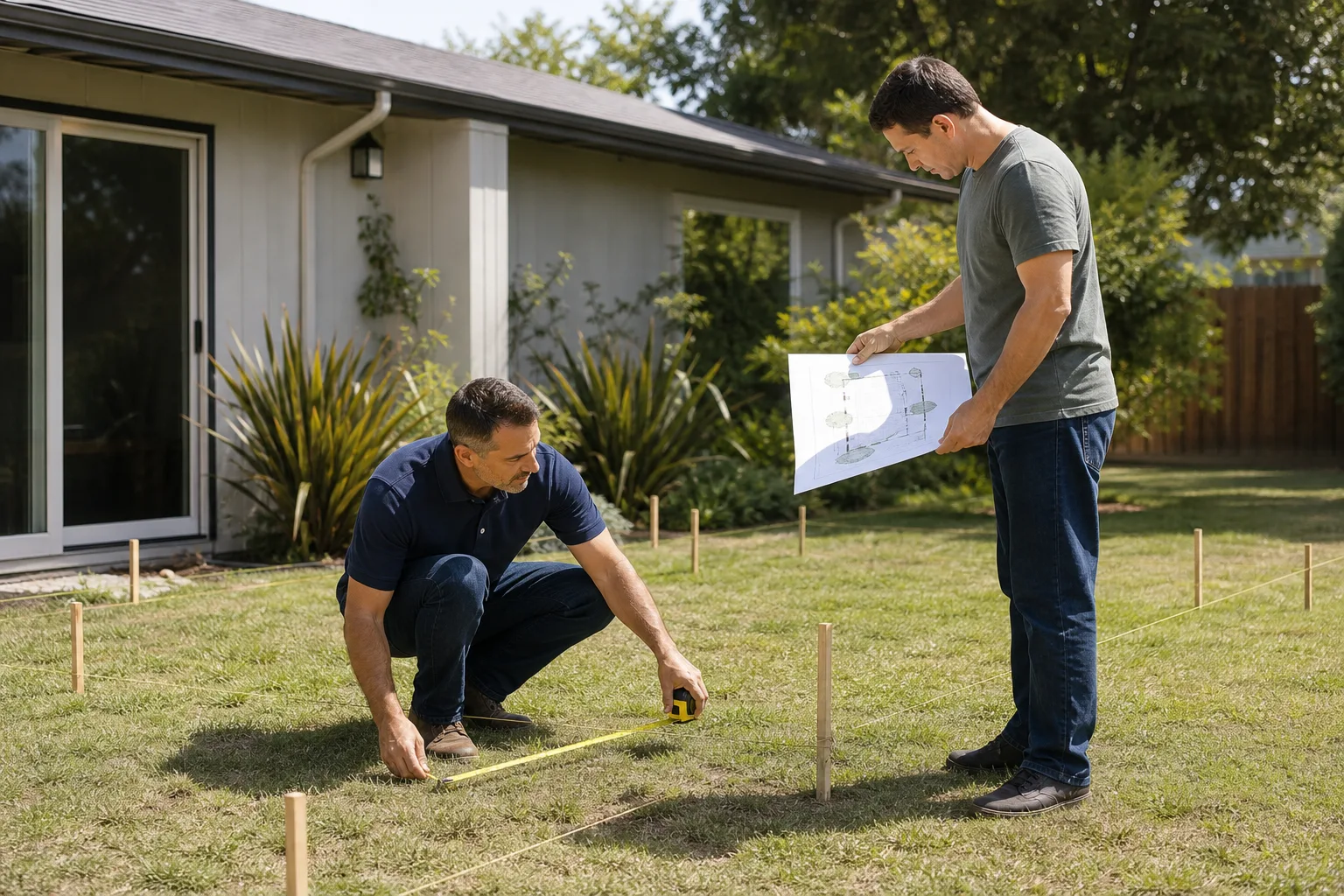
Clark County’s online permit portal is public, and the inspection record on each permit is the single most useful document you can pull on a property before you buy or start an ADU. The portal shows every permit filed on a parcel, the permit type, the contractor of record, the license number, and a dated inspection log. You can pull this yourself in about ten minutes.
Here’s the sequence we recommend to any Las Vegas homeowner assessing a property:
- Search the parcel by address on Clark County’s permit portal (or the city of Las Vegas and city of Henderson portals, since the jurisdiction depends on where the property sits).
- Identify every permit tied to the address, including the original house construction permit and any additions, conversions, or accessory structures.
- Open each permit’s inspection log and read the inspection types in order. A healthy record reads sequentially: foundation, framing, rough electrical, rough plumbing, rough mechanical, insulation, drywall, final.
- Flag any permit where a later inspection passes without an earlier required one. Framing passed but no rough electrical? That’s your anomaly.
- Check the contractor of record against the Nevada State Contractors Board license lookup and confirm the license was active during the entire construction window.
- Confirm a final inspection is logged. A permit can sit “open” for years, and an open permit is a problem when you go to sell.
In our experience, a permit record that reads cleanly is rare on older Las Vegas properties, especially in neighborhoods with a lot of investor flips. The clean records are also the ones that tend to close on time and at the written price. If you’re putting together a fresh permit set for a new project, our ADU Design & Permitting in Las Vegas page walks through what a complete submittal includes.
Inspection Gaps: The Warning Sign Most Homeowners Miss
An inspection gap is when the sequence breaks. The most expensive version is a framing inspection that’s been signed off with no rough electrical inspection recorded at or before that date. The implication is straightforward: the walls were closed before an inspector saw the wiring. Concealed electrical is the single most expensive defect to correct because the fix means opening the wall again, and you’re paying for finish repair twice.
The gaps we see most often on Las Vegas ADU projects:
- Framing passed, rough electrical missing. Walls closed over wiring. Fix requires opening drywall and re-inspection.
- Rough plumbing missing, but insulation passed. The plumbing inside the wall cavity was never pressure-tested on record.
- Final inspection missing entirely. The permit stays open indefinitely. Real estate closings get held up, and some lenders won’t fund on an open permit.
- Inspection with no inspector name or date. A legitimate log names the inspector and dates every entry. A blank or signed-only entry warrants a call to the county.
Why does this matter more in Las Vegas than in most markets? Because a large share of active ADUs here were added to existing houses rather than built from the ground up, and additions get their inspections in phases that are easy to skip. A garage conversion, in particular, has a long inspection sequence: framing, electrical, plumbing, mechanical, insulation, drywall, and final. Each one has to happen, and skipping one means opening the wall later. If you’re converting a garage, our Garage Conversion ADU in Las Vegas page covers how the inspection sequence runs on that path.
Caliche Soil and Structural Warning Signs in Las Vegas
Las Vegas sits on layers of caliche, a calcium-carbonate cemented soil layer that ranges from gravel-hard to cement-hard. Builders either dig through it or, more often, build on top of a graded pad engineered for it. The pad is where problems start. When the pad isn’t engineered correctly or the slab edge loses the soil support it was poured against, you get differential settlement, and differential settlement shows up as specific cracking patterns.
The patterns to watch for on an existing ADU or one you’re considering buying:
- Diagonal cracks at door and window corners. A crack running from the corner of an opening outward at roughly 45 degrees is the classic signature of one part of the foundation moving relative to another.
- Slab edge lifting or a visible gap between the slab and the surrounding grade. The slab has lost contact with the soil beneath or beside it.
- Sticking doors and windows that weren’t sticking a year ago. The frame is racking because the foundation beneath it is moving.
- Interior drywall cracks that run from the top of a door frame to the ceiling, or a crack that keeps coming back after a patch.
- Exterior stucco cracks that run vertically at the corner of the building. Stucco moves with the wall behind it, so a vertical crack often means the wall has shifted.
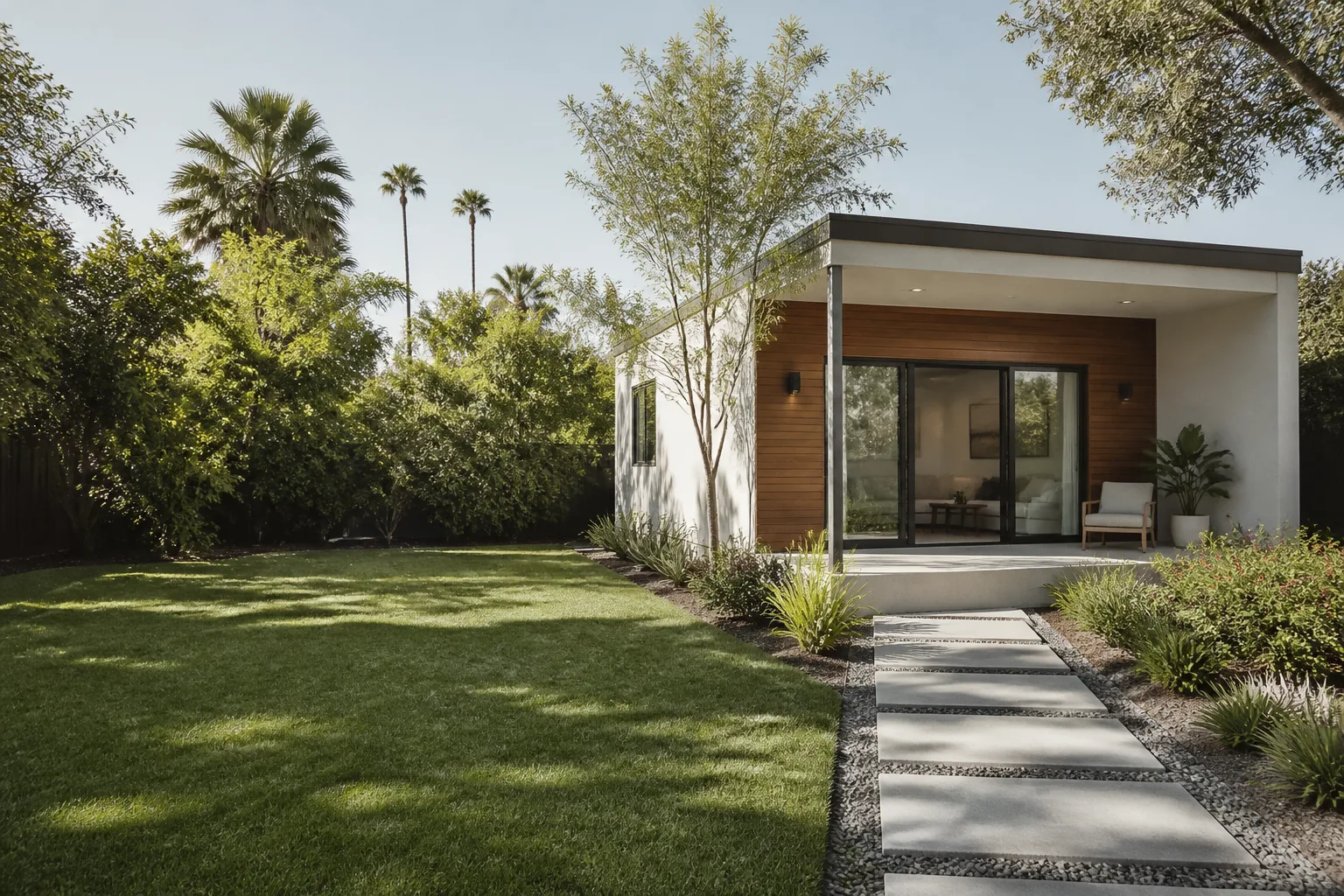
A structural engineer should read any of these before you decide the ADU is fine. The fix is often a soil or foundation repair rather than a cosmetic patch, and a patch hides the evidence without solving the cause. Our team specifies slab and foundation prep as part of site work on new builds; our New Detached ADU in Las Vegas page describes how the foundation prep and permit review work together.
Desert HVAC Warning Signs: Short-Cycling and Undersized Equipment
A Las Vegas summer is the most demanding HVAC test in the country, and it exposes undersized equipment quickly. Ambient temperatures above 105°F mean a unit that was specified for a cooler climate simply cannot keep up. The two signatures we’ve seen on thousands of Clark County homes are short-cycling and setpoint failure.
Both are easy to check on your own:
- Note the temperature outside and the setpoint on the thermostat. Wait 30 minutes.
- Check the temperature inside the ADU or room. If the system is running continuously and can’t reach setpoint at 105°F ambient, the equipment is likely undersized for the space.
- Listen to the compressor. If it runs for five or six minutes and shuts off for five or six minutes, that’s short-cycling, which points to oversized equipment, a refrigerant charge issue, or an airflow restriction.
- Look at the air handler filter and return grille. An undersized return is a common short-cycling cause in conversions, because the original garage door opening was never designed as a return path.
In a garage conversion ADU, the HVAC warning is almost always about the return. The original garage was an unconditioned space, so no one planned a return duct path. A conversion that doesn’t add proper return sizing will short-cycle no matter how good the equipment is. Manual J load calculations are required for a permitted ADU in Clark County; if the contractor can’t produce one, that’s a documentation warning sign. Our guide to the Ellery ADU Studio Las Vegas home page describes how HVAC sizing sits inside the permit set on a typical project.
Documentation Red Flags: Closed Permits, Lapsed Licenses, Missing Notices
Here’s the part most ADU guides skip. Documentation problems cost more than structural ones, because they can kill a sale, stop a refinance, or force a demolition of otherwise-fine work. Five red flags you should check before anything else:
- Closed permit with no final inspection logged. The county closed the permit administratively without the final. Sometimes a fee fixes it; sometimes it means the work was never inspected. Either way, it’s a call to the county before you proceed.
- Contractor license that lapsed during construction. Check the Nevada State Contractors Board license history against the construction dates on the permit. A lapsed license during the build can void your ability to make a claim on the bond.
- No recorded Notice of Completion. Nevada law requires a Notice of Completion filed with the county recorder to start the clock on lien rights. No Notice means mechanics lien exposure hangs over you indefinitely.
- No written contract or a contract missing scope, price, and schedule. Nevada requires a written contract for residential work above $1,000. A handshake is not a contract.
- No documented photo record. The only evidence that a rough-in was done correctly is a photo of the rough-in, taken before the wall closed. No photos, no evidence.
Every one of these is checkable in an evening. Ellery’s practice on every project is a documented photo record and a written permit set the client keeps; Haven Standard Clause 5 (No Surprises) locks the scope at signing so the written scope matches the actual build.
Contract Warning Signs Before Construction Starts
The window to catch contract problems is narrow: before you sign. Once the contract is signed and construction starts, the leverage is mostly gone. The best documentation in the world can’t fix a contract that was wrong from the beginning.
Look for these before you commit:
- Lump-sum bid with no line-item breakdown. You can’t evaluate a price you can’t see. Itemized line items (site prep, foundation, framing, electrical, plumbing, HVAC, finishes, permit fees, contingency) are the only way to compare two bids or see where the money is going.
- Verbal allowances for fixtures and finishes. “We’ll pick that later” during negotiation turns into a change order during construction. Write the allowance amount and the fixture brand into the contract.
- No written price before work begins. If the contract states a range instead of a number, the number is decided later, usually by the person holding the saw. The written price point is the whole point.
- Design and construction as separate contracts. Two contracts means two parties to blame and one homeowner caught between them. A single design-build contract puts both in the same contract.
- No warranty language. Either the work is warranted in writing or it isn’t. Haven’s 365-Day Done Right Promise is a written warranty that a client can produce on request.
If you already have a written estimate in hand, Ellery offers a free second opinion on that estimate, in writing, before you sign. We also name our price in writing upfront – Haven Standard Clause 1 – and we coordinate prefab systems from makers like Plant Prefab, Tuff Shed, and James Hardie inside the same contract, so there’s one written price and one party responsible for it.
Common Mistakes to Avoid
- Trusting the zillow listing’s “ADU” label without pulling the permit history. A detached structure with a mini-fridge isn’t automatically a permitted ADU in Clark County. The permit record is the only evidence that counts.
- Treating a cosmetic fix as a structural fix. Patching a diagonal crack at a door corner without a structural assessment hides the evidence, and on Las Vegas caliche the underlying settlement will keep moving.
- Accepting a lump-sum bid because the number was lower. The lower number is only lower until the change orders arrive. Demand line items so you can compare like with like.
- Skipping the contractor license history check. Verify the license directly with the Nevada State Contractors Board against the construction dates on the permit, not against a screenshot from the contractor.
- Assuming the final inspection happened because the inspector stopped coming around. An inspection that was supposed to happen and didn’t is a problem, not an approval.
- Choosing a prefab system you can’t coordinate locally. A modular unit from an out-of-state maker still needs local site prep, foundation work, utility tie-ins, and permit coordination. Coordinate the whole path or skip the prefab system for now.
- Ignoring HVAC sizing until the first summer. Manual J loads are cheap on paper and expensive after move-in. If the contractor can’t show you the calculation, that’s the warning sign.
When to Call a Professional
Call a professional if you see any of these on an existing or proposed ADU in Las Vegas: an inspection gap in the permit record (framing signed off with no rough electrical), an open permit with no final, a contractor license that lapsed during construction, diagonal cracking at door or window corners, a slab edge lifting away from the grade, an HVAC system short-cycling or failing to reach setpoint above 105°F ambient, or a written contract that quotes a lump sum with verbal allowances. Any one of these caught early is fixable; several caught late can force a rebuild. Ellery ADU Studio Las Vegas offers free estimates in Las Vegas – call (866) 779-3194, and if you already have a written estimate from someone else, we’ll give you a second opinion on it in writing for free.
Frequently Asked Questions
Pull the permit record from Clark County’s online permit portal (or the city of Las Vegas or Henderson portal, depending on jurisdiction) using the property address. Open each permit’s inspection log and read the inspection sequence in order: foundation, framing, rough electrical, rough plumbing, rough mechanical, insulation, drywall, final. Any inspection that passed without the prior one implies concealed work was never inspected. If you’d rather have a second set of eyes, Ellery can read the record with you on a free estimate call.
An inspection gap at the rough electrical stage is usually the most expensive. The fix means opening drywall, re-inspecting, and refinishing, and it happens after the walls are already closed. In our experience on Clark County projects, electrical rework is the line item that turns a small budget overrun into a large one. Call (866) 779-3194 for a free estimate on what a proper rework would cost.
It can be, but only when the pad wasn’t engineered for it or the slab edge has lost support. Caliche itself isn’t the issue; differential settlement across the pad is. The signature to watch for is diagonal cracking at door and window corners, or a visible gap between slab and grade. A structural assessment before you buy or build is the right move. Our new detached ADU work specifies the foundation prep inside the permit set, with a written price before any work starts.
Run the system for 30 minutes and check whether it reaches setpoint when outdoor ambient is above 105°F. If it’s running continuously and failing to hold setpoint, the equipment is likely undersized. Then listen for short-cycling (roughly equal run and off periods), which points to oversized equipment or an airflow restriction. Ask the contractor for the Manual J load calculation, which Clark County permits require. If they can’t produce it, treat that as a documentation warning sign.
A lump-sum bid with no line-item breakdown, verbal allowances for fixtures and finishes not written into the contract, a written price stated as a range rather than a number, and design and construction split across two contracts. Any one of these lets scope drift after signing. Haven Standard Clause 1 requires a written price before work starts, and Clause 5 locks the scope at signing – if a contractor’s contract can’t show both, that’s the warning sign.
Yes. Ellery offers a free second opinion on any written estimate you already have in hand, and we put our opinion in writing. Bring the estimate, the permit record if the project is in progress or already built, and any contracts. We’ll walk the line items and point out the inspection and documentation gaps. There’s no urgency and no obligation – just an honest read of what you’re being quoted.
The Bottom Line
The expensive ADU problems in Las Vegas are administrative before they’re structural. Inspection gaps, closed permits without finals, lapsed contractor licenses, missing Notices of Completion, and lump-sum bids with no line items are the warning signs that cost the most money. Structural signs – diagonal cracking at door corners, slab edge lifting on caliche, HVAC failing at 105°F ambient – are the end result of those administrative failures, not the start of them. Catch the paperwork first, read the inspection log in order, and demand a written price and a written scope before anything is signed. That’s the discipline that decides whether an ADU is a long-term asset or a long-term problem.
Call (866) 779-3194 for a free estimate on your Las Vegas ADU project. Ellery ADU Studio offers a free second opinion on any written estimate you already have, a written price before any work starts, and a documented photo record on every visit. A live person answers calls 24/7, and Haven Standard’s 365-Day Done Right Promise backs the work in writing.
Written by the team at Ellery ADU Studio Las Vegas.