Last updated November 17, 2026
The Complete Junior ADU & Interior Conversion Guide for Las Vegas Homeowners
Nevada’s JADU statute allows a junior ADU within the walls of an existing single-family home, but the statute does not override Clark County’s requirement for a full permit set, a deed restriction recorded with the county, and an owner-occupancy covenant. Most JADU projects in Las Vegas begin without any of these three items in place. That gap is where budgets collapse and where units end up unpermitted, uninsurable, and legally unmarketable. This guide walks through the process in the order the building department actually asks for it: what Nevada law defines, what Clark County inspects, what the deed restriction must say, and what the work costs. You’ll leave knowing the dollar ranges, the code items that trip interior conversions, and how Las Vegas zoning and HOA rules change the math.
Quick Answer
A junior ADU (JADU) in Las Vegas is an interior conversion of existing space inside a single-family home, capped at 500 square feet, with an efficiency kitchen and its own bathroom, plus a recorded owner-occupancy deed restriction filed with Clark County. Typical all-in cost runs $18,000 – $32,000 for basic bedroom separation with a wet bar, and $45,000 – $75,000 for a full kitchen and bath addition, with permit and inspection fees itemized separately. The permit set, fire separation, and egress compliance are the three items most projects get wrong.
Table of Contents
- What Nevada Actually Defines as a JADU
- How Nevada’s JADU Rules Differ From California’s
- What a JADU Conversion Costs in Las Vegas
- The Code Items That Sink Interior Conversions
- The Clark County Permit Process, Step by Step
- HOA Rules, NRS 278.02391, and Reasonable Restriction
- The Deed Restriction and Owner-Occupancy Covenant
- Common Mistakes to Avoid
What Nevada Actually Defines as a JADU
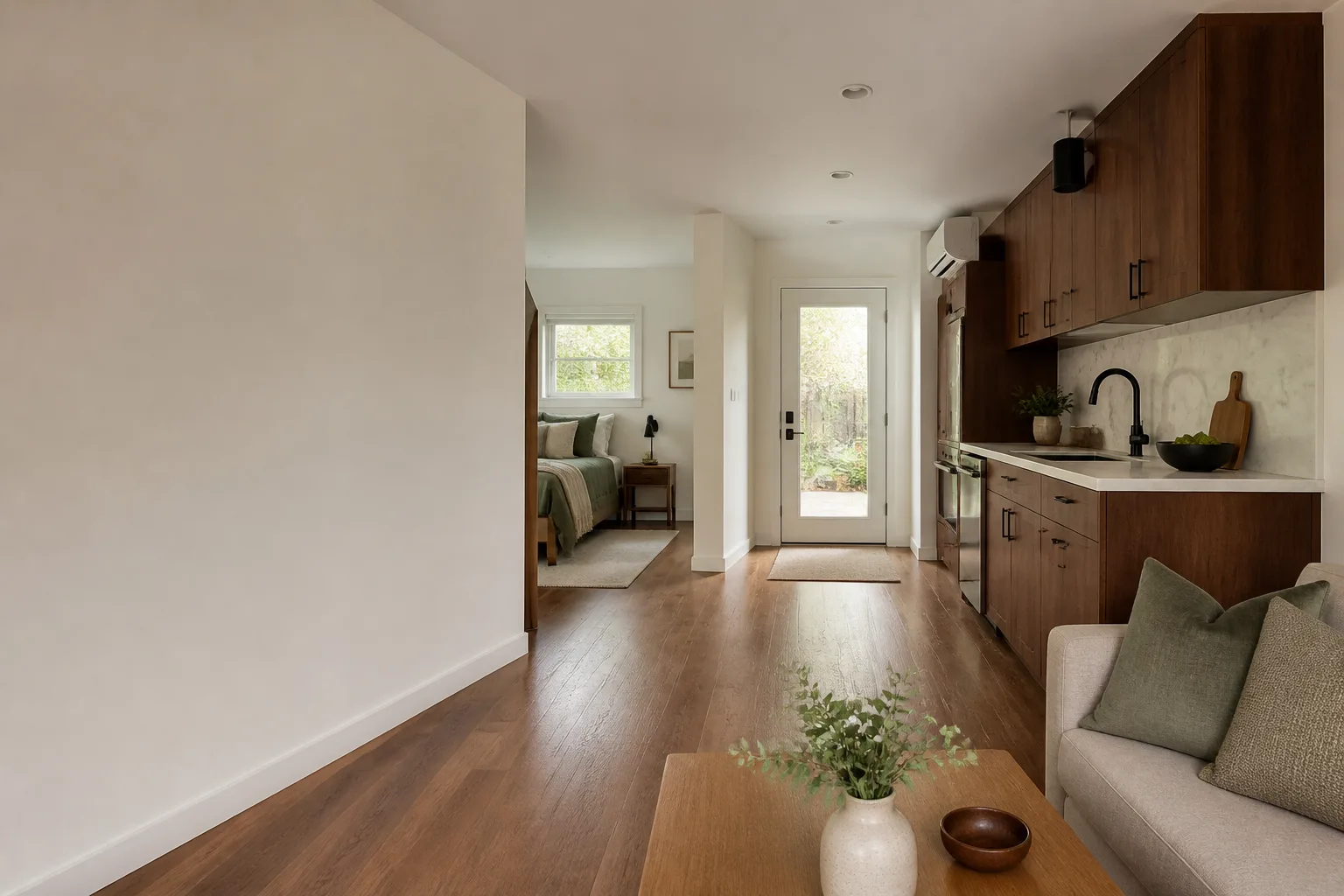
Nevada Revised Statutes and Clark County code define a junior accessory dwelling unit as a smaller, subordinate unit carved out of the existing walls of a single-family home. It is not a detached structure, it is not a garage conversion, and it cannot add square footage to the footprint. The unit must sit inside the home’s already-permitted conditioned envelope.
The statutory parameters that govern a Las Vegas JADU:
- Maximum size: 500 square feet. This is a hard cap under Nevada statute; you cannot carve out 650 square feet and call it a JADU, even if the space exists.
- Efficiency kitchen required. That means a sink, a cooking appliance, and a refrigerator – a mini-fridge and microwave pass, a sink alone does not.
- Full bathroom required. The JADU cannot share plumbing fixtures with the primary unit. A wet bar and a shared bathroom is not a JADU – it’s a bedroom with a kitchenette.
- Owner-occupancy covenant. The homeowner must live in the primary unit. This is recorded against the deed, not promised verbally.
- One JADU per single-family lot. A second junior unit is not permitted alongside a full ADU on the same parcel under county rules.
In our experience, most of the “JADU projects” that arrive at our desk in Las Vegas are actually just interior remodels with a kitchenette – not legally JADUs, and not entitled to the same allowances. The distinction matters because lenders, appraisers, and insurers all read the same definition.
How Nevada’s JADU Rules Differ From California’s
Nearly every JADU guide you’ll find online was written for California. The rules diverge in specific ways, and applying California’s statute to a Las Vegas property will cost you a failed inspection or a stopped permit file.
The main differences:
- Size cap. California allows a JADU up to 500 square feet too, but the state also permits a broader range of configurations. Nevada’s 500 square foot limit is strict and doesn’t flex for larger existing rooms.
- Owner-occupancy. California eliminated the owner-occupancy requirement state-wide; Nevada retains it, and Clark County enforces it via a recorded covenant (more on this below).
- Deed restriction. California’s JADU deed restriction language was standardized and simplified; Clark County’s recorded covenant includes specific owner-occupancy language and lender notice that must be verified at the title company before filing.
- Parking. Nevada offers a parking allowance for JADUs in transit-adjacent parcels, but the exact radius differs from California’s statutory half-mile. Confirm against current Clark County code before you site the unit.
- Separate systems. California lets JADUs share some systems under specific conditions; Nevada’s plan reviewers routinely require separate mechanical and electrical service to the JADU.
The practical takeaway: do not use a California template for a Las Vegas permit set. The building department will send it back. For a primer on how this plays out at the full design and permitting stage, our ADU Design & Permitting in Las Vegas page covers the paperwork side.
What a JADU Conversion Costs in Las Vegas
A Las Vegas JADU conversion runs $18,000 – $32,000 for a basic bedroom separation with a wet bar, and $45,000 – $75,000 for a full kitchen and bath addition. Permit and inspection fees are separate line items, not rolled into those ranges. Here is the breakdown by scope:
- Basic bedroom separation with wet bar: $18,000 – $32,000. Covers wall framing, drywall, a new door, minor electrical for the wet bar, and paint. Does not produce a legal JADU under Nevada law (no full bath).
- Full kitchen and bath addition: $45,000 – $75,000. New plumbing rough-in, fixtures, a real stove and fridge, a full bathroom, upgraded electrical panel if needed, and finish work.
- Permit set (drawings + engineering): $4,000 – $9,000 depending on existing conditions and whether structural work is required.
- Clark County permit and inspection fees: typically $1,200 – $3,500, itemized on the permit application.
- Deed restriction recording and title work: $400 – $900, handled by the title company.
- Fire separation upgrades (if not already present): $2,500 – $6,000 for a rated corridor or ceiling assembly between the JADU and the primary unit.
Every Ellery project is quoted with a written price before any work begins, per Haven Standard Clause 1. The words “call for a quote” don’t appear on our site, and the number on your estimate is the number on your final invoice unless the scope changes in writing.
The Code Items That Sink Interior Conversions
Three code items account for the majority of interior conversion failures in Las Vegas. Each has a specific fix, and each must be resolved before the permit set is submitted.
1. Egress window sizing in converted bedrooms
Every bedroom carved out of existing space needs an emergency escape and rescue opening that meets the building code. That means the window’s clear opening must hit the minimum size (roughly 5.7 square feet of clear area with minimum height and width dimensions), the sill must sit within the allowed height from the floor, and it cannot be obstructed by furniture or by a security bar that doesn’t have a quick-release. In Las Vegas homes built in the 1990s and 2000s, the bedroom windows are often too small. Replacing the window and reframing the opening runs $1,200 – $3,500 per bedroom.
2. Fire separation between the JADU and the main unit
The JADU must be separated from the primary living area by a rated assembly – typically a one-hour fire-rated wall or ceiling. This is not a claim subject to interpretation; the plan reviewer will specify the assembly, and the inspector will verify it during the framing walk. Where the JADU shares a ceiling with the main unit, that ceiling must be upgraded. Budget $2,500 – $6,000 if the assembly isn’t already in place.
3. Mechanical system separation
Clark County plan reviewers require the JADU to have its own mechanical heating and cooling service. A shared HVAC system with a single thermostat fails review. A dedicated mini-split runs $3,500 – $8,000 installed, and a separate electrical sub-panel runs $1,800 – $4,500 depending on the service size at the main panel.
These are the items we identify during the pre-drawing site walk, before the permit set is drafted. Finding them after permit issuance – which happens routinely on projects that skip the walk – is where budgets go sideways.
The Clark County Permit Process, Step by Step
The permit process for a Las Vegas JADU has six steps, and the deed restriction is filed near the end of it, not at the beginning. Here is the sequence:
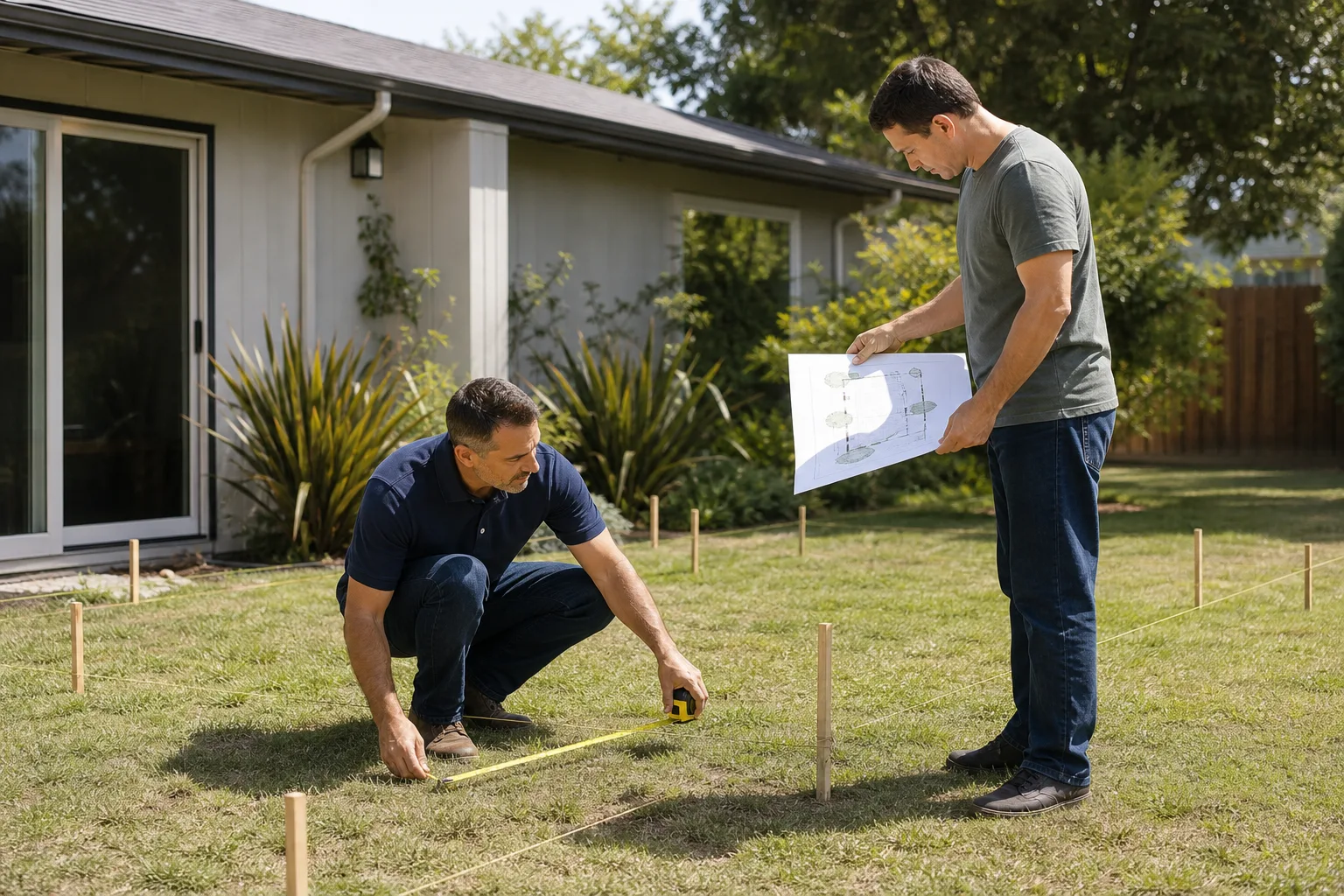
- Pre-drawing site walk. Confirm existing ceiling height, slab, panel capacity, window sizes, and fire separation. This is where the project’s real cost is determined.
- Draft the permit set. Architectural drawings, structural calcs if walls are being moved, mechanical, electrical, and plumbing plans. A complete set moves through review in one pass; an incomplete set goes back and forth.
- Submit to Clark County. File the permit application with the deed restriction language attached. The title company handles the covenant recording separately.
- Plan review. County reviewers respond with comments; the set is revised and resubmitted until approved. A clean first submission typically clears in 3 – 6 weeks.
- Construction and inspections. Rough framing, rough mechanical/electrical/plumbing, insulation, drywall, then final. Each phase requires an inspection sign-off before the next begins.
- Final inspection and certificate of occupancy. The JADU cannot be legally occupied or marketed as a rental until the final inspection is signed off.
The full picture of how a conversion plays out on the construction side lives on our Garage Conversion ADU in Las Vegas page, which covers the parallel route for garage-based units. If you’re considering a detached structure instead, our New Detached ADU in Las Vegas page walks through the different permitting path.
HOA Rules, NRS 278.02391, and Reasonable Restriction
Nevada Revised Statute 278.02391 limits how far an HOA can go in restricting an ADU or JADU. An HOA cannot impose an “unreasonable restriction” on the unit. The statute doesn’t define “unreasonable” in one clean sentence, so Las Vegas courts have interpreted the term mainly by looking at whether the restriction effectively eliminates the homeowner’s statutory right to build the unit, or merely limits the way it is built.
The practical limits of that protection:
- Interior modifications are largely outside HOA reach. An HOA generally cannot prohibit a JADU built entirely inside the conditioned envelope if it doesn’t alter the exterior, the roofline, the footprint, or the number of utility meters visible from the street.
- Exterior modifications remain subject to CC&Rs. If your JADU requires a new exterior door, a mechanical screen, a vent relocation, or a change to the stucco finish (very common in Las Vegas’s stucco-dominated neighborhoods, from Summerlin to Green Valley), the HOA can review and impose architectural standards on those items.
- Owner-occupancy can be enforced by the HOA. If your CC&Rs already require owner-occupancy, that restriction is not overridden by the JADU statute.
We pull the CC&Rs during the pre-drawing phase, not after permit issuance, so the design doesn’t get redrawn to accommodate an architectural review comment.
The Deed Restriction and Owner-Occupancy Covenant
The deed restriction is the legal mechanism that makes a JADU distinct from an ordinary interior remodel. Without it, the unit exists but isn’t legally a JADU, and the property can’t be marketed or financed as though it had one.
What the covenant must contain:
- Owner-occupancy language. The statement that the primary residence will be occupied by the owner, and that occupancy of the JADU will be limited to the primary unit’s owner or a renter of that unit.
- Use restriction. The unit is residential only; short-term rental carve-outs vary and must be checked against current Las Vegas ordinance.
- Lender notice. The deed restriction must be structured so that a future buyer’s lender can see the covenant during underwriting and confirm the unit complies.
- Release condition. The documentation of how the covenant can be removed if the JADU is later demolished or reabsorbed into the primary unit.
The title company records the covenant with Clark County. Cost runs $400 – $900, and the recorded copy should be part of the project file delivered to the homeowner at closeout. On resale, the recorded covenant is one of the first documents the buyer’s lender asks for. If it’s missing, financing stalls or the JADU is reclassified – and the value you thought you were building disappears from the appraisal.
Common Mistakes to Avoid
- Skipping the deed restriction. Expecting the unit to appraise as a JADU without a recorded covenant is the single most expensive mistake we see in Las Vegas. Without the covenant, the appraiser treats the space as a finished room, not a legal second unit.
- Using a California permit template. Clark County plan reviewers reject sets drafted against California’s JADU statute. The owner-occupancy and mechanical separation requirements differ.
- Forgetting the second mini-split. A shared HVAC fails mechanical review. In Las Vegas summer heat, a JADU without its own cooling isn’t rentable anyway – the tenant will move out by July.
- Assuming the HOA has no say. Interior layouts are mostly protected under NRS 278.02391, but exterior doors, vents, and stucco work are not. Pull CC&Rs before drawing.
- Skimping on egress windows. Older Las Vegas homes frequently have bedroom windows that don’t meet the escape opening minimum. Reframing after drywall is four times the cost of reframing before.
- Telling the insurer after the fact. Homeowner policies can exclude unpermitted units, and a water-damage claim from a unit the insurer didn’t know about can be denied. Notify the carrier at permit issuance.
- Treating the 500 square foot cap as flexible. It isn’t. We’ve seen plans for a 620 square foot “JADU” bounce for two reviews before the homeowner accepted the cap. Reclassify to a full ADU or shrink the unit.
When to Call a Professional
Call when any of the following is true: the property is in an HOA, the existing windows don’t already meet egress sizing, the JADU requires its own mechanical system or panel upgrade, the deed restriction has never been recorded, or you’re being asked to sign a permit application without a permit set attached. Interior conversions look like cosmetic remodels and are not – they are regulated second units with a specific paper trail. A permit set that fails review twice costs more than getting it right the first time. Ellery ADU Studio Las Vegas has designed, permitted, and built 900+ units, and a free second opinion is available on any written estimate you already have in hand. Our technicians have up to 11 years of experience on interior conversions. If you’ve received a bid that doesn’t include a permit set or a deed restriction, that’s the first thing to fix.
Frequently Asked Questions
500 square feet is the hard cap under Nevada statute. The cap applies to the interior converted space, not to the total home, and a JADU cannot add square footage to the footprint. If your space exceeds 500 square feet, the unit is either downsized or the project reclassifies as a full ADU with a different permit path. Call (866) 779-3194 for an exact quote on your specific scope – estimates are free.
Yes. Clark County requires a recorded owner-occupancy covenant against the deed before the JADU is legally recognizable. The title company records it, it runs $400 – $900, and it must be in the project file for resale and lender underwriting. Without it, the unit isn’t a JADU in the county’s eyes, regardless of how well it’s built.
Basic bedroom separation with a wet bar runs $18,000 – $32,000. A full kitchen and bath addition runs $45,000 – $75,000. Permit set drafting ($4,000 – $9,000), county fees ($1,200 – $3,500), and deed recording ($400 – $900) are separate line items. Every Ellery project carries a written price before work starts, per Haven Standard Clause 1. Call (866) 779-3194 and we’ll put a written number on your scope before you commit to anything.
NRS 278.02391 limits HOA restrictions on ADUs and JADUs, and interior-only modifications are largely outside the HOA’s authority to prohibit. The HOA retains the right to review and impose architectural standards on exterior changes – doors, vents, stucco, and screening – and can enforce an existing owner-occupancy requirement. Pull your CC&Rs before designing.
Not on an Ellery project. The written price is locked at signing per Haven Standard Clause 1, and scope changes require a written change order signed by you before any work happens. If the pre-drawing site walk finds a reason the number has to move, we find it before the estimate – not after the drywall is up. Call (866) 779-3194 and we’ll walk a scope with you in writing.
Yes, always. A JADU is a legal second unit and requires a full permit set through Clark County plus inspection sign-offs at every phase. Unpermitted units can’t be legally rented, are typically excluded from homeowner insurance, and lose appraisal value on resale because the buyer’s lender treats the space as a finished room rather than a legal unit. Free second opinion available on any estimate that doesn’t include a permit set.
The Bottom Line
A JADU is the cheapest legal ADU path in Las Vegas, but only if the paperwork is right. Nevada’s 500 square foot cap, the efficiency kitchen, the separate bathroom, the recorded owner-occupancy covenant, and the fire and mechanical separations are all non-negotiable – and none of them appear in the California-sourced guides most homeowners start with. The dollar ranges are real: $18,000 – $32,000 for a wet-bar setup, $45,000 – $75,000 for a full kitchen and bath. Permit sets and deed recording are separate. HOA restrictions under NRS 278.02391 protect interior work but not the exterior. Get the permit set and the covenant first, and the rest of the project stays on the rails.
Start at our Ellery ADU Studio Las Vegas home page to see how the design-build model works, then book a free estimate. Call (866) 779-3194 – a live person answers 24/7, and a free second opinion is available on any written estimate you already have. Your written price is issued before work starts, your photo record is delivered on every visit, and the 365-Day Done Right Promise backs the work in writing. That’s Haven Standard Clause 1 and the 365-Day Promise, and they apply to every JADU project we take on in Las Vegas.
Written by the team at Ellery ADU Studio Las Vegas.