Last updated November 17, 2026
Junior ADU & Interior Conversion Troubleshooting: Common Problems and How to Fix Them
The most expensive JADU problem in Las Vegas is not a failed inspection. It is a completed unit that cannot be legally rented because the owner-occupancy deed restriction was never recorded. The unit is finished, the permit is closed, and the rental income the owner planned for is unavailable until a legal correction is filed with Clark County, a process that can take months. We have watched this happen to owners who spent six figures on a conversion. In this guide we walk through the five sequencing failures that produce most JADU and interior conversion problems in Las Vegas, how to identify each one, and how to fix it.
Quick Answer
Most Junior ADU and interior conversion problems trace to two sequencing errors, not construction defects: a scope written before existing conditions were documented, and a permit set submitted before the owner-occupancy deed restriction was drafted. The five failures we see most in Las Vegas are an unrecorded deed restriction, a bedroom that fails egress after framing, a kitchen that does not qualify as an efficiency kitchen under Nevada code, HVAC not separated in the permit set, and a permit that never reached final inspection. Each is correctable if it is caught before construction closes.
Table of Contents
- The Deed Restriction Problem: When a JADU Can’t Be Rented
- The Egress Problem: Bedrooms That Fail After Framing
- The Kitchen Equipment Problem: Efficiency Kitchen vs. Wet Bar
- The Mechanical Separation Problem: Shared HVAC and Inspection Failure
- The Permit Closure Problem: JADUs Without Final Sign-Off
- How to Sequence a JADU Correctly in Las Vegas
- Common Mistakes to Avoid
- When to Call a Professional
The Deed Restriction Problem: When a JADU Can’t Be Rented
Every Junior ADU in Nevada carries an owner-occupancy requirement. That means the property owner must live in either the main house or the JADU, and the restriction must be recorded as a covenant against the deed before the unit can be used as a legal rental. When that covenant is missing, the JADU is a finished building that cannot be legally leased. The permit may be closed. The certificate of occupancy may be issued. The income is still not available.
Here is what usually went wrong. The permit set was submitted, the property owner went through plan review, the covenant was discussed at the counter, and then quietly never filed. Or the covenant was drafted but never recorded with the Clark County Recorder because a title search pulled a different legal description than the one the recorder needed. In either case, the fix after the fact is a corrective deed restriction: a new covenant drafted to the county’s current form, executed by the owner, notarized, and recorded against the parcel.
How to fix it, in order:
- Pull the recorded deed and any recorded restrictions from the Clark County Recorder’s public index to confirm what is actually on title.
- Request the current owner-occupancy covenant template from the county’s ADU desk. Forms change; do not reuse an older version.
- Have the covenant executed with the legal description matching the recorded deed exactly. A one-word mismatch in the subdivision lot description sends the document back.
- Record the covenant and file the recorded instrument with the permit file.
- Notify any lender in first position, because the covenant is a restriction of record.
The title consequence is the part buyers do not fully price in. A sale that closes before the correction is recorded creates a title exception the buyer’s escrow will flag, and it can push the sale past the loan lock period. We’ve seen it delay closings in Las Vegas for 60 to 90 days while a corrective covenant was completed and recorded. If you are planning to list the property, correct the deed restriction before you list, not during the escrow period.
For context on the design and permitting stage where this document should be drafted, see our page on ADU Design & Permitting in Las Vegas.
The Egress Problem: Bedrooms That Fail After Framing
A bedroom conversion in a Junior ADU must satisfy the emergency egress requirements for a sleeping room: a door or an openable window that meets minimum clear opening dimensions, with a sill height that allows exit without obstruction. In Las Vegas stucco-and-furring construction, the failure we see most is a window that looked large enough on the design drawings but does not have the net clear opening the code requires once the frame, casing and security screen are installed. The inspector measures the clear opening, not the rough opening.
The symptoms appear right after framing inspection. The window is installed, drywall is about to go up, and the measurement on the clear opening fails. A retrofit that satisfies egress in Las Vegas stucco typically means cutting a new opening in the exterior wall, framing a new header, installing an egress-rated window unit, patching the stucco, and repainting the exterior wall to match. That is a project, not a punch-list item.
Approximate retrofit cost range:
- Egress window retrofit, single opening, stucco wall, Las Vegas metro labor and materials: roughly $4,000 to $8,500 depending on opening size, header detail, and whether the exterior requires re-stucco beyond the patch.
- Exterior repaint to match wall: $800 to $2,200, depending on the wall area and whether the original finish is a two-coat stucco that will show a shade difference.
- Interior drywall, trim and paint restoration around the new opening: $600 to $1,400.
The preventive fix is cheap: on the design drawings, specify the net clear opening dimension the code requires, and have the window unit manufacturer’s specification sheet pulled before framing. We check that number at plan review, not at framing inspection, because the cost of a new opening is roughly seven times the cost of specifying the right window the first time.
The Kitchen Equipment Problem: Efficiency Kitchen vs. Wet Bar
Nevada building code defines an efficiency kitchen as a food preparation area with a cooking appliance, a sink, and refrigeration. A wet bar has a sink and counter space but no cooking appliance and no refrigerator. That distinction matters because a JADU is permitted as a long-term dwelling unit with an efficiency kitchen. If the build installs a wet bar and the occupant later adds a hot plate, the unit is a dwelling that does not match the permitted drawings, and the certificate of occupancy can be at risk.
The failure path starts at the final inspection or at rental licensing. A rental licensing inspector who finds a freestanding hot plate in a wet-bar layout can flag the unit as an unpermitted kitchen use, which can trigger a re-inspection and, in some cases, a code enforcement referral. We’ve seen this in Las Vegas rental licensing requests for units in the older neighborhoods around the eastern valley and in the rental-heavy pockets near the Strip corridor.
What the distinction requires, concretely:
- Cooking appliance: a range, cooktop, or wall oven wired and vented per the mechanical and electrical drawings.
- Sink: plumbed, with hot and cold supply and a drain to the building drain line as shown on the permit set.
- Refrigeration: a dedicated circuit for a refrigerator, shown on the electrical plan.
- Ventilation: a range hood or exhaust fan vented to the exterior, sized to the cooking appliance.
The fix after the fact is a permitted revision to the electrical and plumbing plans, an inspection of the new circuits and connections, and a re-inspection of the kitchen area. That is a permit revision, not a construction project, and it is far cheaper if you catch it before the electrical rough-in closes.
The Mechanical Separation Problem: Shared HVAC and Inspection Failure
A JADU is a separate dwelling unit. Under the mechanical code and the JADU requirements, the unit needs its own heating and cooling source, or a documented zoned system with a separate thermostat controlling only the JADU. Sharing the main house HVAC without documenting how the JADU is controlled in the permit set is the fastest path to a failed mechanical inspection.
The failure pathway is predictable. The permit set shows a single split system for the whole house. The contractor taps a duct into the JADU from the main system. The mechanical inspector asks where the JADU thermostat is, and the answer is that there isn’t one. The inspection fails, the unit has no separate control, and the plan revision now has to be drawn, submitted, and approved before the drywall can close. In Las Vegas, that sequence is expensive because the summer cooling load does not allow a unit to sit un-conditioned through June, July, and August while the revision works through plan review.
What the permit set needs to show to avoid the failure:
- A separate thermostat and a separate zone damper, or a dedicated mini-split system serving only the JADU.
- Duct routing drawn to the JADU and insulated to the exterior-air standard for the climate zone.
- The electrical panel schedule showing the dedicated circuit for the JADU condenser or the zone controller.
- A calculation of the JADU cooling load, which for a 500-square-foot Junior ADU in Las Vegas summer conditions is often a one-ton mini-split.
We specify a dedicated mini-split rather than a zoned tap in most Las Vegas JADUs because the supply air from a main-house system has to travel too far and the temperature swing in a 110-degree August is too wide for a shared duct. The cost of a one-ton mini-split installed is roughly $3,800 to $5,600, and the cost of a failed inspection plus a permit revision plus a re-inspection in the middle of summer roughly doubles it.
The Permit Closure Problem: JADUs Without Final Sign-Off
A building permit that was issued and never brought to final inspection is a permit that can stall a sale, a refinance, or a rental licensing approval. In Clark County’s public permit records this shows up as a permit status of “issued” or “open” with no final inspection recorded, even though the work was completed. This is one of the most common problems we see when buyers purchase a Las Vegas property that already has a JADU.
How to identify it in public records, in order:
- Search the Clark County building permit portal by the parcel number, not the street address, because permit records are indexed to the parcel.
- Pull the permit history for the parcel and identify every permit that touches the JADU or the garage: design, electrical, plumbing, mechanical, and the JADU permit itself.
- For each permit, confirm the inspection record shows a final inspection with a passed result and the permit status is closed.
- Cross-check the recorded certificate of occupancy if one is on file with the county.
Bringing the permit to final after the fact is a voluntary disclosure. The process involves a permit reactivation request, a field inspection of the completed work, correction of anything the inspector identifies, and then the final inspection and close-out. The cost range for bringing a Las Vegas JADU permit from open to final, on completed work that passes on the first inspection, is roughly $900 to $2,400. If the inspection identifies corrections, that range widens substantially, and we’ve seen cases reach $6,000 to $12,000 when the corrections included electrical or egress work.
Voluntary disclosure before a sale is far cheaper than a title company discovering the open permit during escrow, because at escrow the sale is contingent on the correction and the schedule is out of the seller’s control. Our page on the Garage Conversion ADU in Las Vegas walks through the permit history on garage-to-JADU conversions specifically.
How to Sequence a JADU Correctly in Las Vegas
Every one of the four problems above is a sequencing problem. If the deed restriction is drafted before the permit set is submitted, the recording happens alongside the permit. If the egress dimensions are on the design drawings before framing, the window is specified correctly. The order of operations is the fix.
The order that avoids the failures:
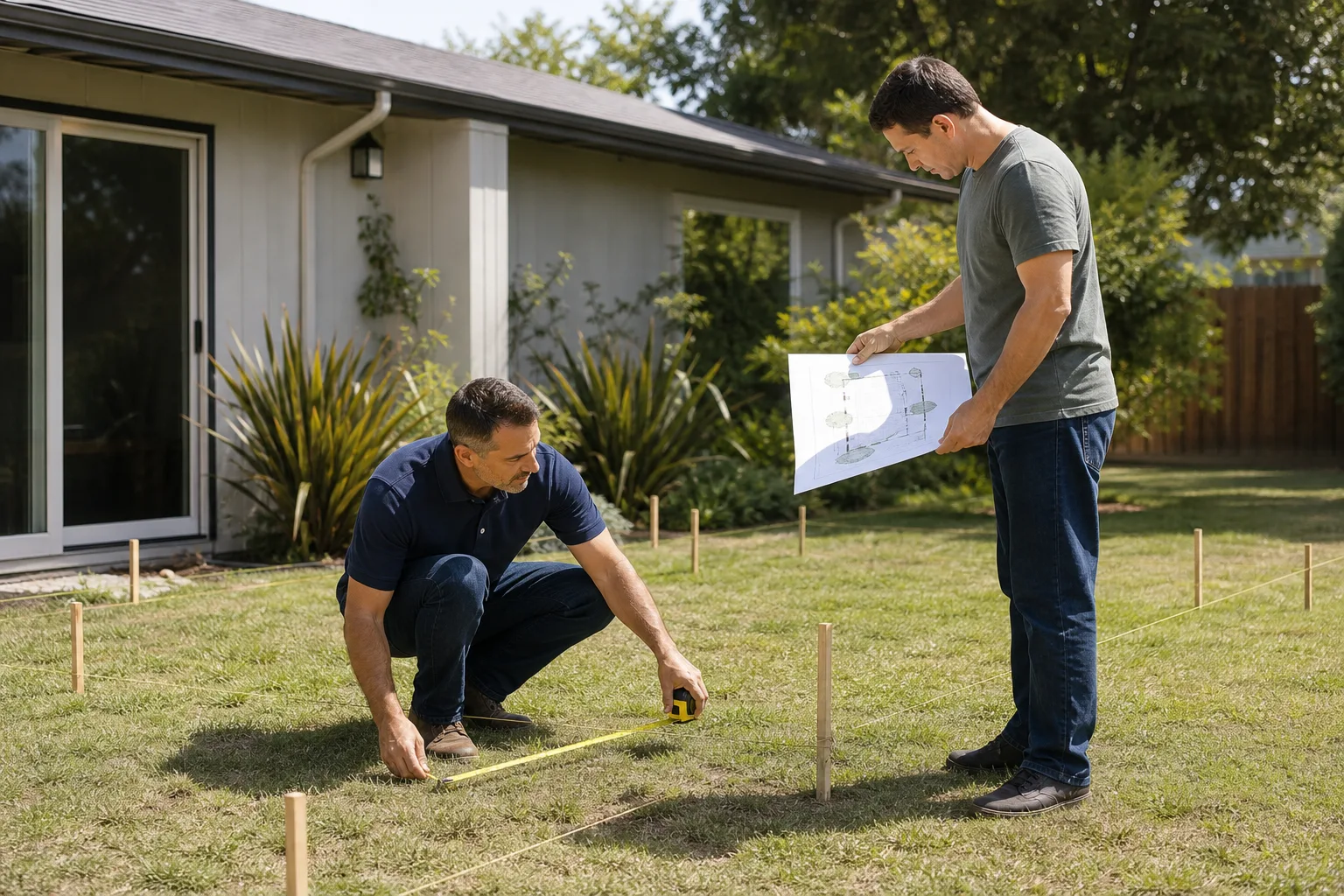
- Existing conditions survey. Measure the wall assembly, the slab, the ceiling height, the electrical panel capacity, and the existing HVAC. On Las Vegas stucco construction, that means opening a small inspection hole if the wall assembly is not documented. The photo record from this step is the basis for the scope.
- Draft the owner-occupancy covenant and the scope simultaneously. The covenant is part of the legal package that supports the permit, not a document to be produced later.
- Draw the permit set to the surveyed conditions. The egress opening dimensions, the efficiency kitchen layout, the separate HVAC circuit, and the duct routing appear here, not at framing.
- Submit the permit set and the covenant package together. Include the owner-occupancy covenant and the parcel legal description in the submittal.
- Inspect on the schedule the permit requires. Framing, rough electrical, rough plumbing, rough mechanical, insulation, and final, in that order. Do not close the wall on any rough inspection that has not passed.
- Obtain the final inspection and the certificate of occupancy. Record the covenant if it was not recorded at permit issuance.
If you are weighing a detached unit against an interior conversion, our page on the New Detached ADU in Las Vegas explains what the detached process requires in addition to the interior conversion sequence. And if you are working with a prefab or modular panel system from Abodu or Cover, the same sequence applies, with the manufacturer’s panel drawings and the site survey merged into one permit set before submittal. Our team has coordinated those systems, plus James Hardie cladding and Tuff Shed outbuildings, on Las Vegas parcels where the existing conditions needed documenting before the panel order went out.
Common Mistakes to Avoid
- Recording the covenant after the certificate of occupancy. In Las Vegas this is the single most common cause of a completed JADU that cannot be rented. The covenant should be drafted with the scope and recorded alongside the permit package.
- Specifying egress by rough opening instead of net clear opening. The inspector measures the clear opening with the window fully open. A rough opening that is 40 inches across can yield a clear opening that fails egress once the frame and security screen are installed.
- Installing a wet bar and calling it an efficiency kitchen. A wet bar is a sink and counter. An efficiency kitchen needs a cooking appliance, a sink, and refrigeration, each on the permit drawings. Las Vegas rental licensing treats the two differently.
- Sharing the main-house HVAC without documenting the JADU control. A tapped duct with no separate thermostat is a mechanical inspection failure in any Las Vegas summer and will require a plan revision before the wall can close.
- Skipping the existing conditions survey on older Las Vegas housing stock. A 1950s ranch in the eastern valley and a 2000s build in the western valley have different slab thickness, wall assembly and panel capacity. A scope written without opening the wall will produce change orders at framing.
- Buying a property with an existing JADU without pulling the permit history. An open permit or a missing covenant transfers to the buyer. Search the Clark County permit portal by parcel number before the inspection contingency expires.
- Closing the wall on rough inspections that have not passed. Every correction after drywall costs roughly three times what it costs before drywall, because the wall has to be opened, re-inspected, and patched. The photo record from each rough inspection is the evidence that the work matched the drawing.
When to Call a Professional
Call a licensed professional when the problem involves opening an exterior wall for an egress retrofit, revising an electrical panel to add a dedicated HVAC circuit, or recording a deed restriction against title, because each of these carries a code or legal consequence that a homeowner cannot certify. Call us as well if you are purchasing a Las Vegas property with a JADU and the permit history is unclear: we can pull the record and identify the open permit before your inspection contingency expires. And call us if a prior contractor left a JADU without a final inspection, because a voluntary disclosure filed early is measurably cheaper than a title issue discovered at closing.
Ellery ADU Studio Las Vegas offers free estimates in Las Vegas, with a written price before any work begins and a free second opinion on any written estimate you already have in hand. Call (866) 779-3194 to schedule your free estimate.
Frequently Asked Questions
The most common problem is an unrecorded owner-occupancy deed restriction on a completed Junior ADU. The unit is finished and the permit is closed, but the covenant required for legal rental was never recorded with Clark County, so the owner cannot lease the unit until a corrective deed restriction is drafted, executed and recorded.
An egress window retrofit in Las Vegas stucco construction typically costs $4,000 to $8,500 installed, depending on opening size, header detail, and how much exterior wall has to be re-stuccoed and repainted beyond the patch. Interior drywall and paint restoration adds roughly $600 to $1,400.
A Junior ADU needs its own heating and cooling control, either a dedicated system or a documented zoned system with a thermostat serving only the JADU. Sharing the main-house HVAC without a separate JADU thermostat in the permit set will fail the mechanical inspection and require a plan revision before the wall can be closed.
Search the Clark County building permit portal by the parcel number, not the street address, and confirm that every permit touching the JADU shows a final inspection with a passed result and a closed status. Bringing an open permit to final after the fact typically costs roughly $900 to $2,400 if the completed work passes the first inspection.
An efficiency kitchen has a cooking appliance, a sink, and refrigeration. A wet bar has a sink and counter but no cooking appliance and no refrigerator. A JADU permitted as a dwelling unit needs the efficiency kitchen, and installing only a wet bar creates a unit that does not match the permitted drawings.
You can list the property, but the title company will flag the missing covenant as an exception and the sale will be contingent on the correction. That correction can take 60 to 90 days, so completing the corrective deed restriction before you list is the way to keep the sale on your schedule rather than the county’s.
If you want a free second opinion on a written estimate you already have, or on a permit package that is in front of you, Ellery ADU Studio Las Vegas reviews it at no cost. Start at the Ellery ADU Studio Las Vegas home page or call us directly.
The Bottom Line
Junior ADU problems in Las Vegas are almost always sequencing problems, not construction problems. The deed restriction drafted after the permit, the egress window specified by rough opening, the wet bar sold as an efficiency kitchen, the shared HVAC with no JADU thermostat, the permit never brought to final: each one is correctable, and each one costs a fraction of the repairs if it is caught before the wall closes. The fix is a documented existing-conditions survey before the scope is written, a permit set that carries the egress, kitchen and mechanical details, and a deed restriction drafted and recorded alongside the permit. Under the Haven Standard, every project comes with a written price before work starts, a documented photo record at each visit, and a 365-Day Done Right Promise in writing. Call (866) 779-3194 for a free estimate.
Written by the team at Ellery ADU Studio Las Vegas.